Find answers to the most common questions about
growing bamboo in Florida, investing, and FBGA membership.
Bamboo Farming Basics
The primary variety grown by FBGA members is Dendrocalamus asper, commonly known as Giant Asper bamboo. It is a clumping (non-invasive) tropical bamboo that thrives in Florida’s subtropical climate. It is prized for its large, edible shoots and potential wood applications. Clumping varieties are preferred for commercial farming because they stay contained and do not spread aggressively like running bamboo.
A large-plant cultivar of Dendrocalamus asper was imported by Kingdom Bamboo approximately one year ago. This holds the promise for increased future harvest of culms for pulp and textile processing. Over the course of more than a year, the USDA conducted multiple growth cycle evaluations to assess the presence of harmful pathogens. The tested plants have been officially certified as free from all harmful pathogens included in standard screening protocols. The next phase will involve initiating tissue culture propagation using the clean, certified plant material, and then producing growing stock at scale. This variety is expected to be available in 2028.
The bamboo varieties used in commercial farming by FBGA members are clumping bamboo species, which are not invasive. Unlike running bamboo varieties, clumping bamboo expands slowly and stays within its planted area. Invasive bamboo concerns are associated with running bamboo, which is not used in Florida commercial operations. Proper species selection and management practices ensure bamboo farming is environmentally responsible.
Dendrocalamus asper is one of the fastest-growing plants in the world. In Florida’s subtropical climate, established bamboo clumps can produce new shoots that grow several inches per day during peak growth season. Commercial production is typically reached within 4–5 years of planting, after which the farm can be harvested annually for decades.
Once established, a bamboo farm can produce commercially for 50+ years with proper management. Unlike annual crops that must be replanted each year, bamboo is a perennial — you plant it once and harvest it indefinitely. This long productive life is a major advantage for long-term return on investment.
FBGA member farms primarily target the jarred/processed bamboo shoot market for food service and retail. Additional markets include:
- Additional food products such as bamboo water and flour
- Bamboo wood for construction materials and hardwood flooring
- Biomass for renewable energy (pellets)
- Biochar for soil amendments
- Feedstock for bio-based plastics (bioplastics)
- Textiles (bamboo fiber for sheets, clothing)
Dendrocalamus asper (Giant Asper) is the primary commercial variety being grown and studied in Florida. UF/IFAS research is actively evaluating optimal variety selection, planting density, and management practices for Florida conditions. The FBGA recommends prospective growers consult with the association and its research partners before selecting varieties for planting.
Investment & Financial Returns
Mature bamboo farms in Florida are projected to generate approximately $5,000 per acre per year in net income from shoot sales. This is a projection based on current market pricing and observed production data — actual returns depend on farm management, variety, soil, and market access. FBGA members have access to detailed financial modeling and IFAS research data to help develop realistic farm business plans.
Startup costs depend on land acquisition, acreage, soil preparation, plant sourcing, irrigation installation, and management setup. Turn-key programs like those offered by FBGA member Greenfield Bamboo Investments bundle land, development, and management into a single investment package that typically has an establishment cost (farm establishment through first commercial harvest) of $20,000-$30,000 per acre. Contact FBGA directors or member farm managers for current per-acre cost estimates.
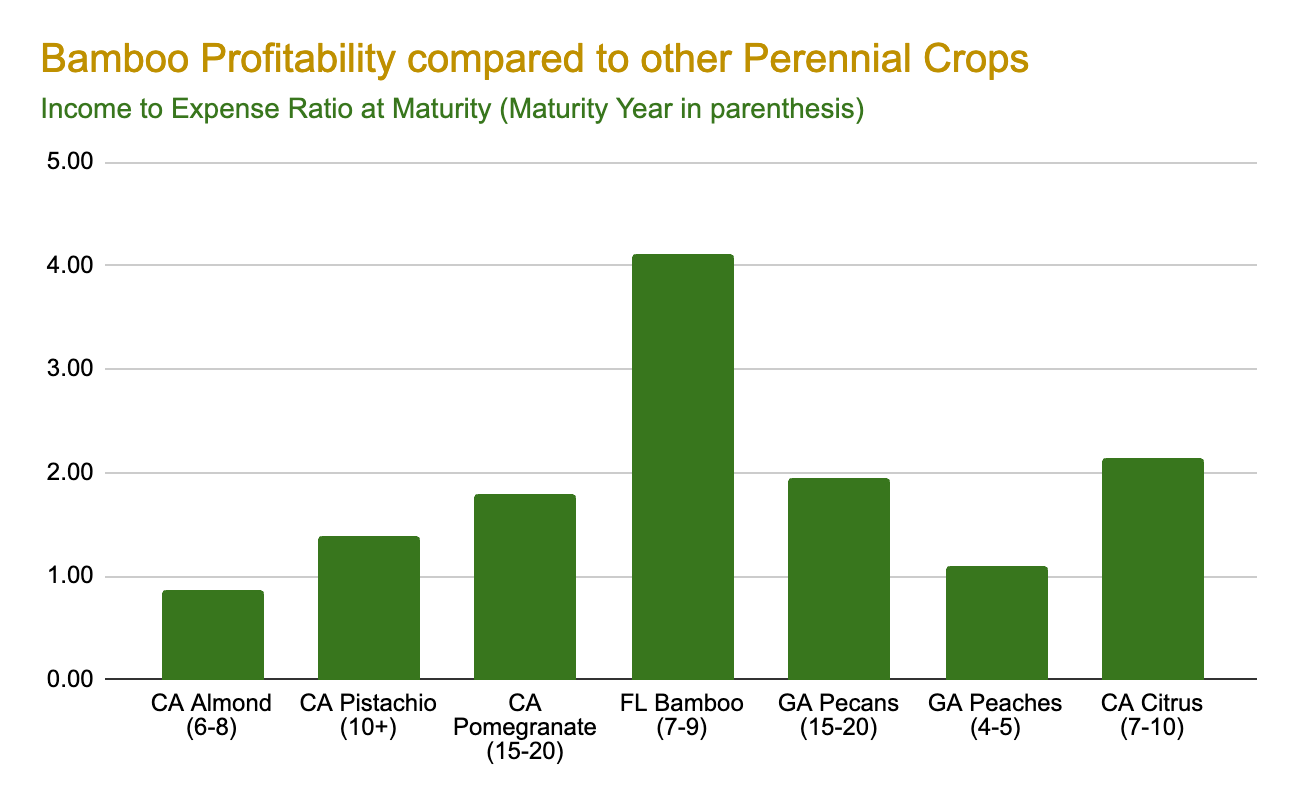
Bamboo farms typically begin producing harvestable shoots in Year 4, with full commercial production typically reached by Year 4–5. The first 1–3 years are considered the establishment phase, during which the farm is growing but not yet at commercial yield levels. Financial planning should account for this ramp-up period.
The FBGA is actively working with USDA to expand program eligibility for bamboo farmers, including crop insurance and disaster relief programs. Some USDA Farm Service Agency (FSA) loans and NRCS conservation programs may already be applicable to bamboo operations. FBGA membership includes guidance on navigating available federal and state agricultural programs.
Starting a bamboo farm
You’ve come to the right place. FBGA has all the information you need on best management practices for growing bamboo.
A turn-key bamboo farm is a fully managed agricultural investment where the investor owns the land and crop, but a professional farm management company handles all operational aspects — including land acquisition, site preparation, planting, irrigation, fertilization, harvesting, and marketing. This allows investors with no farming experience to own a productive agricultural asset. FBGA member Greenfield Bamboo Investments is an example of a turn-key bamboo farm management company operating in Florida.
No. Turn-key farm programs are specifically designed for investors who may not live in Florida and have no prior farming experience. The farm management team handles all day-to-day operations and provides regular reporting on farm status, crop progress, and harvest readiness. FBGA member investors include individuals from Oklahoma, Ohio, California and other states.
Turn-key programs provide end-to-end management including experienced local farmers who themselves own and farm bamboo — aligning their interests directly with yours. Monthly reporting, regular farm visits, and responsive communication are standard expectations. The FBGA provides additional oversight and community context for the entire industry.
Yes, in the turn-key model offered by FBGA members, investors hold title and deed to the land. This is a critical distinction from some agricultural investment vehicles; your land is a real, tangible asset that you own, which can appreciate in value over time and can be sold.
Large-Scale & Institutional Investment
Yes! With our proven economics, it is now possible to develop a large scale investment in Florida land as a Land Bank, that is supported by the strong income of bamboo farming.
The global bamboo market exceeds $70 billion and is projected to continue growing. The U.S. bamboo shoot market alone is largely unserved by domestic producers, with demand driven by both traditional Asian cuisine and a growing health-conscious consumer base embracing bamboo as a nutritious superfood. Large domestic buyers — food distributors, grocery chains, processors — are actively seeking reliable domestic sources.
Yes. Florida bamboo farming aligns well with several ESG (Environmental, Social, and Governance) and impact investment criteria:
- Carbon sequestration — Bamboo absorbs CO₂ at a high rate, potentially qualifying for carbon credit programs
- Sustainable agriculture — Minimal chemical inputs, perennial crop, soil health benefits
- Rural economic development — Creates agricultural jobs and preserves farmland in Florida
- Supply chain sovereignty — Reduces U.S. dependence on foreign bamboo imports The FBGA welcomes conversations with impact investors, family offices, and institutional agricultural investors.
Bamboo is a highly efficient carbon sequesterer, and there is growing interest in bamboo-based carbon credit markets. While specific protocols for bamboo carbon credits in the U.S. are still evolving, FBGA member farms are positioned to potentially participate in voluntary carbon markets as standards develop. This represents an additional future revenue stream beyond crop sales.
About the FBGA
The Florida Bamboo Growers Association (FBGA) is an independent nonprofit trade association representing bamboo farmers, allied businesses, and research institutions in Florida. It was founded by working bamboo farmers to build the industry infrastructure — scientific research, market development, government program access, and community — necessary for Florida bamboo to become a healthy, competitive, and successful domestic industry.
The FBGA is open to individuals and companies that have an interest in bamboo farming. The FBGA has three membership categories:
- Grower Members ($150/year) — Active bamboo farming operations
- Allied Members ($200/year) — Businesses serving the bamboo industry (farm managers, suppliers, land companies, processors)
- Research Members ($10/year) — Universities and scientific organizations
The FBGA is an independent industry association — it does not sell farms, manage crops, or earn revenue from farm operations. It represents the collective interests of all its members. Farm management companies are FBGA members — they operate within the industry the FBGA is working to build.
The FBGA has partnered with the University of Florida’s Institute of Food and Agricultural Sciences (UF/IFAS) to fund and guide active bamboo research projects covering:
- Key Project – Making the bamboo food crops predictable
- Production potential (how much bamboo can Florida farms realistically yield?)
- Optimal fertilization and nutrition programs
- Irrigation efficiency and soil moisture management
- Ideal planting density
- Bamboo shoot shelf life and post-harvest handling
- Mechanical Harvesting – UF engineers are developing autonomous machines to harvest wood that will overcome high labor costs and enable profitable access to U.S. markets.
- Disease Identification and Management
The FBGA actively advocates for bamboo farmers to have access to the same federal tools available to other agricultural producers — including USDA FSA loan programs, NRCS conservation grants, crop insurance, and disaster relief. The association provides members with current information on applicable programs and assists with the navigation process.
Environmental & Regulatory
Bamboo farming offers multiple environmental advantages:
- Carbon sequestration — Bamboo absorbs CO₂ faster than most tree species
- Low chemical inputs — Bamboo is naturally resistant to most pests and diseases
- Biodiversity support — Bamboo groves provide habitat for wildlife
- Soil health — Bamboo root systems stabilize soil and reduce erosion
- Water quality — Lower fertilizer and pesticide runoff compared to many conventional crops
- Farmland preservation — Keeps productive agricultural land from being sold for development
Florida does not currently have restrictions on clumping bamboo species used in commercial agriculture. Invasive species regulations target running bamboo, not the clumping varieties (such as Dendrocalamus asper) used by FBGA member farms. Growers should always verify current state and local regulations. The FBGA tracks regulatory developments affecting members and provides updates through its Directors Updates.
Bamboo farming operations may qualify for Florida’s Agricultural Land Classification (commonly called the “Greenbelt Law”), which can significantly reduce property taxes on land used for bona fide agricultural purposes. Qualification depends on demonstrating that the land is used commercially for agriculture. Consult a Florida property tax attorney or appraiser for guidance on your specific situation.
Markets & Selling Your Crop
The primary current market for Florida bamboo shoots is the U.S. food market, including:
- Asian grocery retailers and food distributors
- Restaurants and food service operators specializing in Asian cuisine
- Health food markets catering to consumers seeking superfoods
The FBGA is actively working to develop buyer relationships and market infrastructure so that when member farms reach full production, buyers are ready to purchase at scale.
There is no “guaranteed” market for any agricultural crop, but the structural case for domestic bamboo is strong: the U.S. imports the vast majority of its bamboo supply, and buyers actively seeking domestic sources face no shortage of demand. The FBGA’s market development efforts focus on establishing direct buyer relationships and supply agreements ahead of peak production. Members have access to current market intelligence and buyer contacts through the association.
FBGA member Florida Fresh Bamboo has a program offering growers fixed harvest cost and long-term purchase contracts with set price per pound of harvested shoots.
Florida bamboo has potential across multiple markets:
- Wood/construction — Bamboo lumber, laminated boards, flooring
- Textiles — Bamboo fiber processing for clothing and bedding
- Renewable energy — Biomass pellets
- Biochar — Soil amendment product with growing agricultural and environmental markets
- Bioplastics — Bamboo-based bio-materials for packaging and products
The FBGA tracks all of these market verticals and prioritizes those with the nearest-term commercial viability for Florida farms.