
Kevin Barley, Greenfield Bamboo Investments
Harvest Time – Bamboo plants have their first harvest typically in Year 3 and are expected to reach peak production in Year 6. We began our first harvest in late May after watching for shooting activity. In hindsight, we may have started a couple of weeks late. We believe we have had our last harvest for the season the week ended November 2nd.
Harvesting Frequency – – We learned quickly that all the farms needed to be harvested weekly. Our plan was to harvest shoots that were 12”-16” in length and they were growing 10” per week. This meant we needed to be very consistent in our timing. This season we were not perfectly equipped to be consistent with our timing and this resulted in one week of missed harvesting. We harvested a period of 22 weeks and potentially could have begun 2 weeks earlier, so 24 weeks may be a reasonable definition for this season.
Selectivity – most of the shoots in these young plants do not have the base diameter to be suitable for harvesting. Those not harvested grow into new trunks and this is desirable for the plants. We learned during the season working with customers that the small skinny shoots had a small ratio of core bamboo shoot to the total weight and therefore they were undesirable. We refined our specs for the harvesters to a minimum of 3” diameter at the base. This diameter is clearly a function of the plant maturity. As they get older and mature more it is expected that the amount of selectivity will decrease.
Farm Practices Affecting Readiness – We were surprised to find that 32 acres of our better Year-2 farms were ready for harvesting. Our model shows Year 3 as the first year of harvest so these Year-2 farms were unexpected. It became clear that these farms had good farm practices and this had caused greater maturity and production in the plants.
Yields – the yields we encountered in pounds/acre over the season were affected by farm quality, selectivity, the harvest frequency and the length of the harvest period, and some acclimation by our harvesting crews. Of course we all want to validate the Model expectations for production in any way we can. Please recognize that it is not reasonable to draw specific conclusions as we were only harvesting 5.5 acres of 3-Year farms. Still, our best 3-Year farm had about 30%-40% of the anticipated yield. I believe this was driven by factors that will continue to have a bearing on our harvests in the future:
- Our earlier plantings were generally smaller acreage and have lower than average farm quality. Each year the new plantings have increased the average acreage and have been increasingly more commercial in approach. I therefore expect a general increase in farm quality over the next few years.
- While we had an abundance of shoots produced, our harvest was limited due to selectivity. I don’t see this well accounted for in our Model.
The long term productivity may be consistent with the Model as selectivity naturally decreases due to growing maturity. This has caused me to reduce expectations for Year 3 to 3,000 lbs/acre, 10,000 in Year 4 and steadily increasing such that we peak at Year 7 rather than in Year 6. This is guess
work on my part but i’m trying to use what we have to affect our expectations. We used the new assumptions to recalibrate our future forecasts. Total production for this first small season was approximately 17,000 pounds. Next season we expect about 265,000 pounds, about 15x this year’s quantity.
- While our first season had less production per acre than we had anticipated, it was interesting to me to realize that the main 3-year farm (2.5 acres) was achieving 3,000 – 4,000 pounds per acre. After paying harvesting and caretaking the farm is making over $2,000 per acre, a great historical profit for citrus. And this was its first harvest year… not bad.
- Regarding Model validation, I was able to imagine how the mature 3 year old plants might change as they matured and became 6 year old plants. The clumps will likely be 4-5 feet in diameter, have therefore more shoots and we will have no selectivity (they will all be 3” base diameter or greater). Based on this I expect we can harvest an average of 1 shoot per plant each time we harvest. That is 400 shoots per acre with an average weight of 3 lbs so 1,200 pounds/acre. If we harvest 20 times that is 24,000 pounds. The Model is 28,000 pounds/acre, not out of line with that quick example. So my conclusion is that the Model continues to be a potential outcome.
Bamboo Shoots Harvested

Harvest Cost – Harvest cost is borne by the grower but is estimated at 12-15% in the Model. This season was not only a learning experience but it was very inefficient from a harvesting standpoint. The yields per acre were low which translates to higher cost. Greenfield Bamboo provided all of the harvesting crews and charged $.25/lb to everyone. We expect as efficiency and experience increase that the cost will drop. We began with crews that were 5-8 people and quickly realized that the crew size needed to be 2-3. We developed a route of all the farms being harvested and attempted to run that route each week. While this season we had one crew harvesting one day per week, next season could have three harvesting crews running 5 days per week.
Payments and Statements – systems were developed quickly and I was pleased to see that while most production value was applied to Deferment, the grower was able to pay the harvesting expense out of the production before applying the balance to the Deferment. This is not specifically addressed in the contract so i thought Roberto made a nice concession to the growers.
Shelf Life – If you are the only supplier of fresh bamboo shoots then you better be able to provide them very fresh. We initially found this to be challenging. Maximizing shelf life quickly became a priority and we engaged the University of Florida to provide guidance. They helped us to develop post harvest procedures designed to cool the shoots to under 41 degrees F as quickly as possible once harvested. This was done with ice-topping in the field, then hydrocooling (ice water baths) in the packinghouse. In addition we are exploring micro perforated packaging to further extend freshness.
Vision for Packinghouse – – It became clear to me by the end of the season that we want to be able to manage and minimize the cost of the packinghouse and potentially locate them close to production. This enables us to minimize travel time that can affect the shoot’s shelf life. In addition it seems likely that we will have specific equipment required to properly wash, brush, clean, cool and pack the shoots. I see us developing a model with the smallest footprint and cost to accomplish its purpose. These could be owned and run by independents with a fixed cost per pound contract. It is unlikely that we will need an additional packinghouse during the next season. This is just my idea right now.
1st Customers – we were advised by our marketing consultants to not focus on local customers but to engage the real markets of the West and Northeast, home to the Asian American communities. As we worked to gain customers we realized we needed to introduce them to this new product, as “fresh” bamboo shoots were clearly unavailable. This generated some excitement but required us to learn how to ship samples (cold) and to develop a Shoots Card for the grocery store customers which explains our story, gives instructions and has a recipe on the back. These efforts were absolutely necessary and most of our prospects became customers. We currently have 2 of the large chains located in New York City and New Jersey, as well as smaller chains and distributors in Minneapolis and Seattle. We were completely limited in developing new customers by our small production. Each week we produced approximately 1 pallet which is the minimum that can be economically shipped out of state. So having 4-5 regular growing customers meant we couldn’t ship to everyone each week. The customers we developed effectively became partners with us so this was a worthwhile effort. The product when it is fresh is beautiful, reflecting freshness, and the customers Love this. Notice the vibrant colors in the photo following. This is what tells the consumer that it is fresh.

Pricing – we found that we could get $2.50 – $3.00 / lb delivered. We had no competition and expect we may be able to price better in the future. Just know that after shipping cost and packinghouse charges these prices don’t result in a “rise” for grower contracts.
Vision for Marketing – This can take many forms but our early efforts have identified good news – the underlying product, the shoot, is super healthy and nutritious. Many of you know that but from a marketing standpoint this gives us better ability to grow and expand a market that begins with the Fresh Bamboo Shoots, develops next to Fresh Frozen (a processed, longer shelf life version) and ends with taking bamboo shoots to the rest of the country. It’s as if we just found onions… and i told you, these are really flavorful, and they go in everything, and oh, by the way, we own them all! Forgive me for being excited!
The marketing approach builds off having a wonderful product that is local and fresh. I expect that potential brands could procure production contracts from us or partner with us.
Current Farm Development Progress – At the beginning of 2019 we had about 60 farms in Florida with 300 acres. Currently we have 87 farms covering 565 acres. I expect that next year we will plant about 450 new acres.
Managed Farms – Greenfield Bamboo (GB), a very experienced bamboo farm developer, has started creating large farms (50-100 acres) which share a common water source and are managed by Greenfield Bamboo. Investors buy 10 acre blocks to participate. Since we have identified the Asper growing in the citrus belt of Florida as the “sweet spot” for growing bamboo (lower risk and higher return) this is where these farms are located. GB feels it can impact farm quality the most in this environment. GB is just now planting a 65 acre farm in Wauchula (see below).
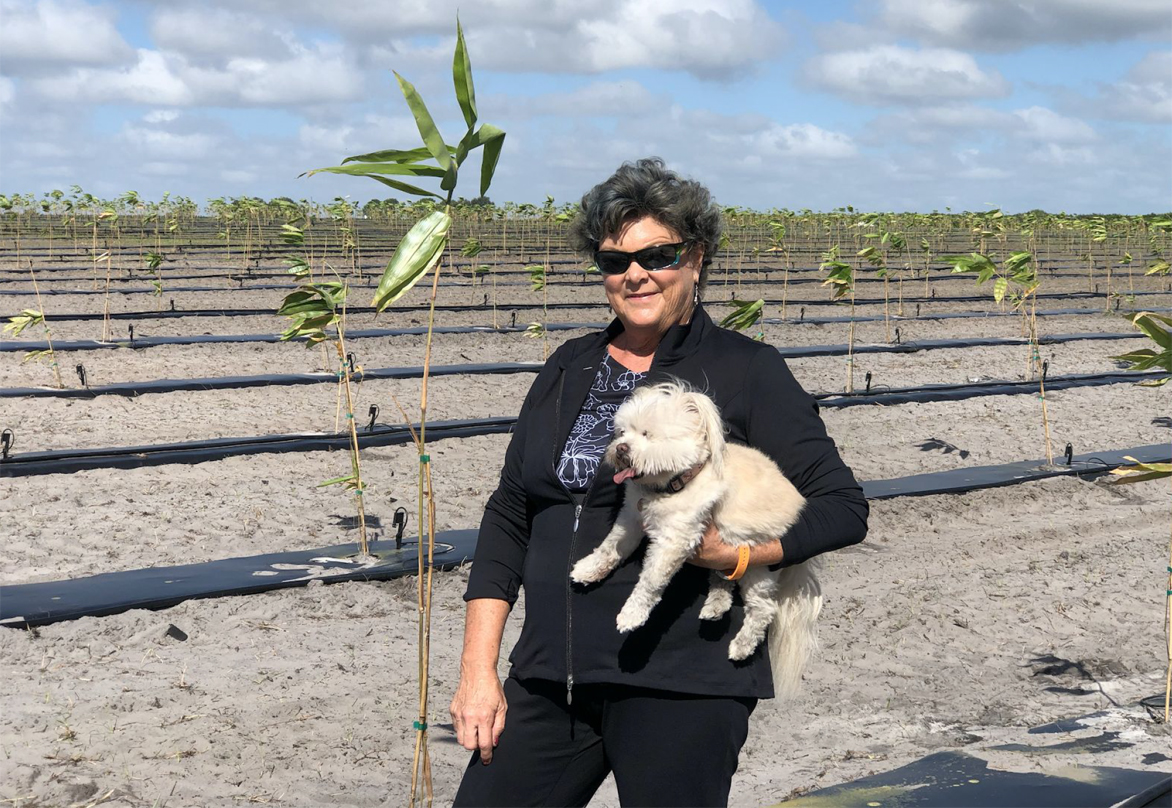
A lot is happening as part of developing this new agriculture industry in Florida. Opportunities abound. Learning as much as possible during the industry development is critical but somewhat natural. I have much more to share so if you have a specific interest let me know. I hope that you and your families are well. Contact me if you have questions. 407-625-5046.