As part of our effort to share what we are learning, last year I wrote “What We Learned in our First Harvest Year”. The learning continues and we have much to share, compiled here in our 2nd Season report.
Many of our Farmer Partners, understandably, long for validation of high production and therefore strong profitability and that this will be a good investment. My own observation is that for this new ag industry to be successful we need 3 things:
- Farmability – it has to be easily farmable at scale.
- Productivity – it has to produce well so that it can generate enough profitability to make it worthwhile.
- Good and Sustainable Market – the market for the crop products has to be good, not just adequate for now but growable for the long term.
*By the way, my view is that we have all 3 things, just work to do in developing the markets.

We are building a new ag industry and are in the pioneering stage. By comparison, Citrus took decades to grow into a mature industry. With this in mind, our update covers many aspects of the developing industry:
- Farming
- Harvesting
- Production Statistics
- Packing
- Marketing
Farming
Trends in Farm Quality – As OnlyMoso brought its concept to the market, they worked with willing new Farmer Partners. This often involved small acreage and the farms didn’t always have the proper structure or receive proper care. This resulted in a large portion of the early farms having lower than intended quality.
Today we can see trends developing towards commercial viability and higher farm quality. In fact, this has caused us to realize that we know what is necessary for farms to develop properly and that every farm should be a successful farm.
Successful Farms – At the beginning of this latest harvest we were surprised that not all of the Year 3 farms were mature enough to participate in the harvest. I polled the farms to get information about what had affected their farm development and it became clear that some farms had structural issues, lacking adequate water or well-drained soil. Some did not utilize professional caretaking and some felt they had been given the wrong direction. Suffice it to say that farm practices greatly impact farm quality and production. The trends today show great promise for future production and commercial viability. We scored 50 farms and determined that farms not saddled with a deficiency had 30% higher scores of farm quality. This is good news!
Farm Quality By Primary Issues

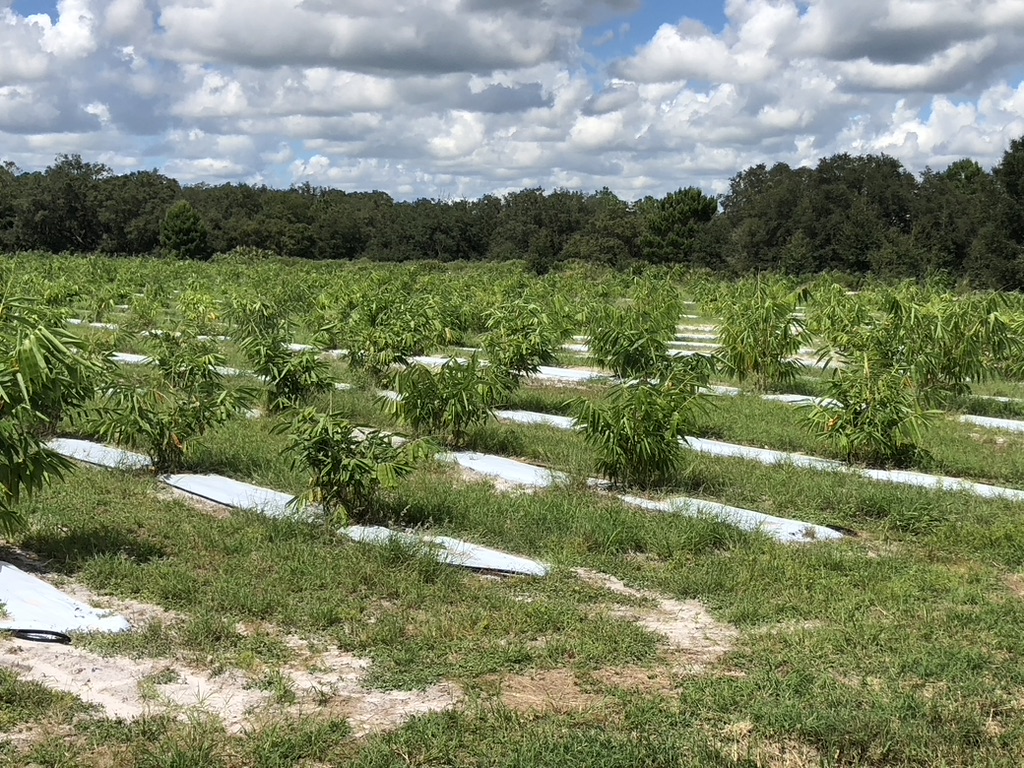
Every aspect of this report points to the conclusion that farming bamboo is a good business. In this vein, we recommend that every farm receive professional Caretaking. See Year 2 farm below showing off its amazing maturity (height over 30 feet, many 4” culms, and greater production/acre than any other participating farm, regardless of age) at a young age.

Greenfield Bamboo Managed Farms – for non-professional farmers Greenfield Bamboo (Ben and Matt) developed the idea of Managed Farms where they could buy the right land (typically 100 acres), obtain it at reasonable prices, build the farm with current best management practices, and provide on-going caretaking and farm management. This became the place where GB could drive commercial viability (imagine your 5-10 acres being part of a 100 acre farm) and farm quality. Below is an example of GB’s new Sorrells 100 Farm added to their existing Sweetwater 100 farm. This allows even small parcel owners of 5 acres to be part of a much larger farm (200 acres) where they can be assured greater cost efficiency.
Planting Practices – as part of our connection with our friends in Australia that worked to develop a commercial bamboo industry there 25 years ago using Asper, we were encouraged to build farms that allowed the plants to grow to their full size (10 foot diameter base at maturity). With this aim a new setting was put in motion of 250 plants per acre rather than the previous 400. This enabled a potentially more favorable environment for farming practices while lowering initial costs by 30%.
Caretaking Practices and Nutrition – We are fortunate to have knowledgeable and experienced Field Support staff to guide us into better ways to grow bamboo. Wes Grainger developed a Program that provided definition to our Mowing, Nutrition and Irrigation practices. Much of this is focused on Nutrition and this continues to develop. Much of the goal is to push the plants towards establishment and maturity, thereby reducing plant vulnerability and maximizing production. Wes worked with Diamond R Fertilizer to develop and improve their own products for use in bamboo farms. We are appreciating the impact in the farms.
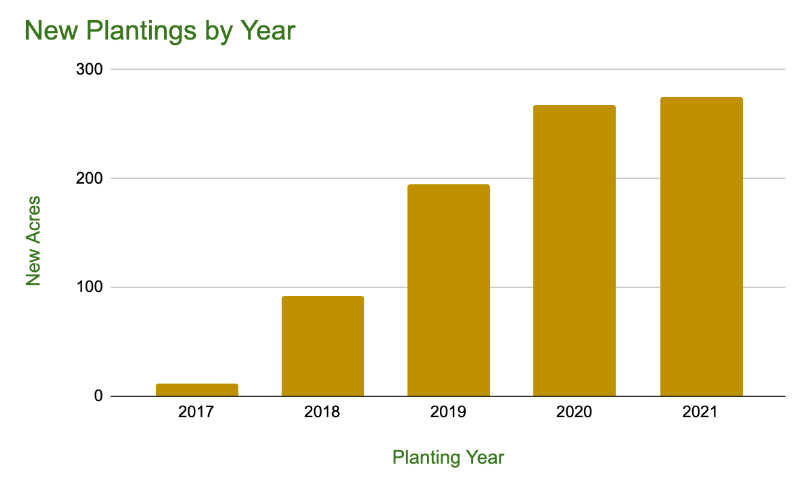
New Plantings in 2021 – In 2021 we have added 29 farms in Florida totaling 275 acres. This brings us to a new total in Florida of 116 farms with 840 acres. We expect a higher quantity of new plantings in 2022.
Harvesting
Third Party Harvesting Crew – it has been our goal to develop competent and competitive commercial harvesters so in 2021 we partnered with JLC Harvesting. They helped to develop the necessary efficiency required in the harvesting process. OnlyMoso Harvest (Ben and Matt) trained the crews in the necessary procedures. Based on the costs incurred we developed a formula to allocate costs according to farm production and distance. My conclusion is that harvesting costs for good farms will start off at around 30-35 cents/lb and as they approach maturity to reduce to around 15 cents/lb. This was good news!
Payment of Harvesting Cost – As OnlyMoso is owed all of the production value to pay Deferment, we were pleased that Roberto agreed to let the production value go first to pay Harvesting and then the balance to pay Deferment. This helps farmers’ early years’ cash flow.
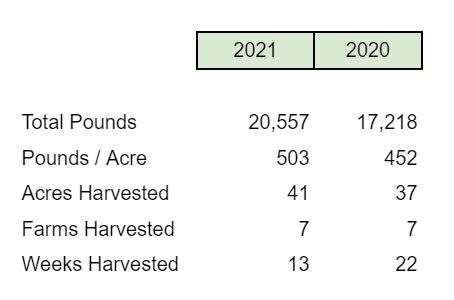
Production Statistics and Perspective on 2021 Season. The harvesting statistics above will leave you wondering without more details, so let me help you:
- We do not have enough acres, farms and consistency in our process to provide meaningful information to reach any conclusion at this point. In the 2020 season we had one Year 3 farm of 2.5 acres and we attempted to develop a better expectation for first year production of 3,000 – 3,500 pounds per acre. We believe that was a good start and we were able to generally validate that in 2021.
We had low participation from Year 3 farms primarily due to inadequate maturity. This is the issue discussed above in Trends in Farm Quality and Successful Farms.
- Our perspective is that the 2021 season was poor, likely driven by weather. We should all expect that weather will cause better and worse seasons and we will be able to understand this with more experience. This season we had a later start driven by a late start to the rainy season. We noticed that production ramped up over the weeks and then had a trending decline over subsequent weeks that was not farm specific, i.e. it affected all of the farms.
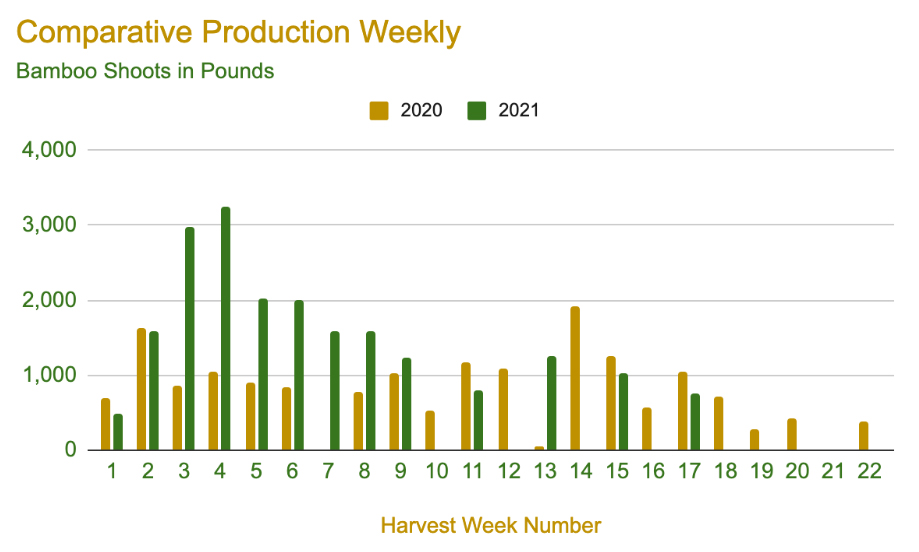
- Low participation and resulting low weekly production, plus supply chain marketing challenges led to less weekly harvests. Without adequate production we began harvesting every other week. We ended the season in early October while shoot production continued in farms until mid-November. We believe that if instead of harvesting 13 weeks we had harvested 20-24 weeks that the harvest would be larger and the pounds/acre would be greater.
- Our new Year 2 farm from Bartow had the highest production per acre of participating farms. Generally we expect Year 2 production to be 1/10 of normal Year 3 production. If you see the farm (photo p.3) it is no surprise as it is the most mature farm of our group.
- Production expectations – our friends in Australia have their own production estimates for Asper and they have published them in their book, Bamboo World. These estimates come from their sources in Thailand where Asper is the primary variety utilized in their commercial bamboo farming. Generally the expectation is 15-20,000 pounds per acre at maturity. This is useful outside and independent research. I suggest that you use this as your new, more realistic expectation. Note that all research is consistent in showing a strong rampup in production from Year 3 to maturity at Year 6 or 7.
- Selectivity – We determined in 2020 that the marketplace would not accept skinny shoots as they didn’t have enough edible portion inside their wrapping. We determined to harvest shoots that have a 3” diameter base or greater. We made efforts to ensure that the 2021 harvests complied with this minimum specification and it felt like this limited production. We are considering whether we might adjust this to 2.5” for the future.

Packing
Plan – We made plans before the season for a larger harvest which would require larger packing and marketing operations. As mentioned earlier, lower participation completely altered this plan.
Part of our objective at this stage was to advance the development of procedures and processes. We developed better organization with a manager, good coordination with the outside harvesting crews, and coordination with marketing for shipping.
Shelf life – We continued to work with the University of Florida in creating longer shelf life of the shoots through our post harvesting procedures and cooling process. We had planned to use a more sophisticated hydrocooling system but with the time and effort to cool large quantities of water to very low temperatures we were guided by UF to shift our focus to Forced Air cooling. This was not implemented this season. However, we implemented high quality coolers which were able to bring the core temperature of shoots down to 34 degrees overnight.

Shelf life – We continued to work with the University of Florida in creating longer shelf life of the shoots through our post harvesting procedures and cooling process. We had planned to use a more sophisticated hydrocooling system but with the time and effort to cool large quantities of water to very low temperatures we were guided by UF to shift our focus to Forced Air cooling. This was not implemented this season. However, we implemented high quality coolers which were able to bring the core temperature of shoots down to 34 degrees overnight.
Low Utilization – Small harvests underutilize the Packing House and result in higher costs/pound. I envision costs in the short term (with significantly better utilization) of 75 cents/lb and longer term at 50 cents/lb. These budget levels are not possible when we pack only 20,000 pounds. We have to be realistic about operating costs at this stage as we are developing an operation for a much larger volume.
Future Options – I mentioned in last season’s report that the Packinghouse goal is to provide the packing, cooling and storage at a low but reasonable cost per pound. It does not require that we own the facility or do it ourselves. The packing operation can be subcontracted to other facilities which are abundantly available. This will be a natural consideration for the future.
Marketing
This was an exciting year for the shoots marketing. We expected a significant increase of production which would translate into much more to move in Marketing. We made a plan to address concerns about reaching the larger market, branding, pricing, logistics and how to make sure we moved all the harvest every week.
Market Development – We had determined that to ramp up to the higher volume we needed to reach the top 30 Asian American grocery store chains in the country. This turned out to be difficult due to various language barriers. But along with some advertising from Roberto, we began to connect with wholesale produce marketers that already had developed networks in these markets. I quickly realized that there is quite a market for fresh bamboo shoots. The stores want them and view them as an opportunity. Individual stores decided to be Wholesalers for us, taking our minimum 1,000 pounds (pallet), and distributing it to the stores in their area. We developed roughly 15-20 wholesalers that theoretically could in total take 20-30 pallets per week.
Branding – We needed to develop a name in the marketplace, known for our freshness and being local. Last season I identified that the shoots, with their vibrant colors, reflect their freshness. This is natural because as they lose the freshness the colors fade to gray and brown. Our freshness not only differentiates us in the marketplace, it is the compelling reason for buying. Rather than focus on a name for the product I developed an artistic symbol to show the vibrant colors and to associate this with our marketing material and our website. Further, we developed a brochure and a Shoots Card, which is displayed with the shoots at the store. The Shoots Card is designed to introduce our fresh product to the customers. Each Shoots Card gives our story, directions and has one of five recipes on the back.

Pricing – We were able to develop consistent pricing across the country for our Wholesalers of $3.25/lb delivered. This was designed to avoid the incessant re-negotiation of prices with every order. It worked!
Competition – Surprisingly, we found competition from other small bamboo farms in all of our markets. These were all “field run”, in other words, they were cut from the field and shipped without going through the washing/brushing/cooling process in a Packinghouse. The difference is obvious – our shoots are pretty, fresh looking and easier for a store to sell. And, we have significantly longer shelf life. But the competitor’s pricing is $1.50 – $2.75/lb. This could require adjustment in our pricing at some point.
Supply Chain – Before the season began we developed better trucking options than the previous season, working to move from $.50+/lb down to $.25/lb. We found that our first option is to have stores do their own pickup at our Packinghouse. Many stores have weekly runs to south Florida to pick up various produce. We also developed relationships with produce haulers that wanted to handle much of our volume. Lastly, we developed brokers that could help. As the season began we encountered what today is called the Supply Chain crises. The stores often could not get trucks to pick up at our Packinghouse. The produce haulers could not even give us a quote as they couldn’t find trucks. We couldn’t get a quote for LTL (less than a load) Reefers except as a full truck. We had plenty of demand but no way to get product to the customers. We began using our own truck which cost $1.00 – $2.00/lb as we were hauling one way. Coupled with our much lower harvest (1 pallet per week), we had no way to reduce cost with higher volume on a truck. Higher volume in the future will give us better options.
Returns and Rise Calculation – I want to help you understand how our marketing results are working out and how this potentially affects farmer returns. As part of this I provide below estimated 2021 costs compared to Near term budgets (what we might expect in volume next season) and Long Term budgets based on much higher volume. Your contract refers to “wholesale brokered cost” which is intended to say that if the harvested shoots were sold immediately from the harvest to someone that packed and marketed the product. This is the same thing as OnlyMoso doing those functions and providing a net return. Your contract provides that if 70% of this return is higher than your fixed minimum price ($1.00/lb) then you get the higher price.

Conclusions – What this tells you is that we are early in the development of the market and working with volumes that are too low to be meaningful. My own perspective having personally worked with the branding, customers and logistics is that I am optimistic. We have a market that is workable but we also have a lot of work to do. Note that I am providing very rough estimates of the 2021 numbers (Packing is likely higher) but their conclusion is without question – there is no potential “rise” for the farmer from this season.
I feel confident in saying that bamboo farms have the 3 things we need here in Florida:
- Farmability
- Productivity
- Good and Sustainable Market
We have work to do but we are all part of developing a new and successful ag industry in Florida. Yippee! Let me provide the disclaimer that my interest is bringing you the facts and with that my own perspective. None of this is intended to speak for Only Moso USA.
I hope that you and your families are well. Contact me if you have questions. 407-625-5046.